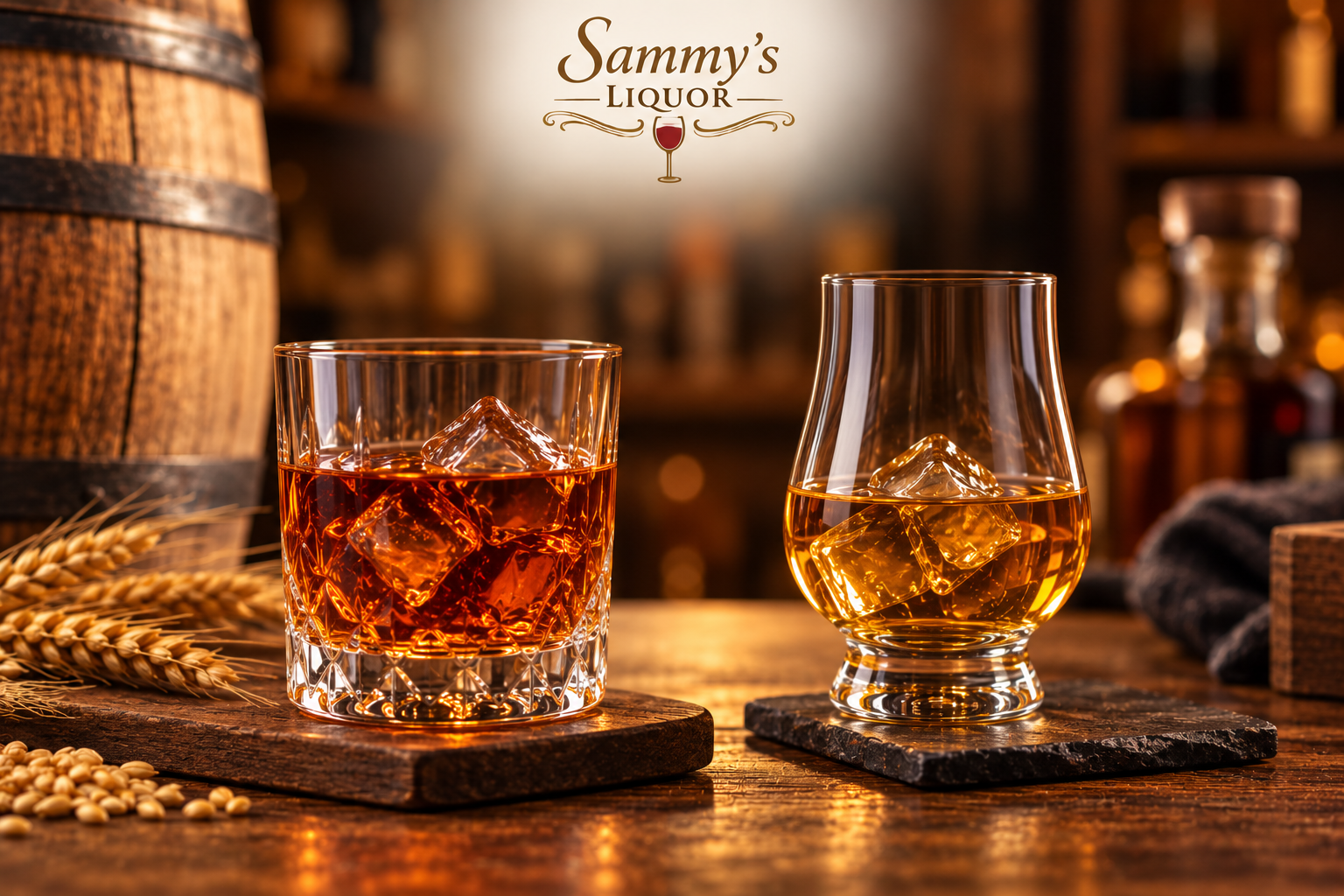
You’re standing in the whiskey aisle, and the labels all start blurring together. Bourbon. Rye. Tennessee whiskey. Straight whiskey. Some bottles say both “whiskey” and “bourbon” right on the front, which only makes things more confusing. If you’ve ever left Sammy’s Liquor without a bottle because you weren’t sure what to grab, you’re not alone.
Here’s the short version: bourbon is whiskey, but not every whiskey is bourbon. Once you understand what separates the two, choosing a bottle gets a lot easier, and picking your next pour becomes part of the fun instead of a guessing game. In this guide, we’ll walk through exactly what makes bourbon different from other whiskey styles, how to taste the difference, and how to pick the right bottle for whatever you’re drinking it for.
With fall settling in and whiskey season kicking off across Moore, this is a good time to get the basics down before you’re back in front of that shelf.
Bourbon vs Whiskey: What Really Sets Them Apart
The confusion usually starts because people treat “bourbon” and “whiskey” as two separate things you’re choosing between, when really, one sits inside the other. Whiskey is the broad category. Bourbon is a specific, legally defined style within that category.
Think of it the way you’d think of “sedan” and “car.” Every sedan is a car, but not every car is a sedan. Scotch, rye, Irish whiskey, Tennessee whiskey, and bourbon are all whiskey. What makes each one distinct is a combination of where it’s made, what grains go into it, and how it’s aged.
Once you understand what has to be true for a whiskey to earn the bourbon label specifically, the rest of the whiskey aisle starts to make a lot more sense.
What Actually Makes Something “Whiskey”?
At its core, whiskey is a distilled spirit made from fermented grain, then aged in wooden barrels. That’s the broad definition, and it leaves a lot of room for variation.
Depending on where and how it’s made, whiskey can lean sweet, smoky, spicy, or smooth. Producers use different grains (corn, rye, barley, wheat), different barrel types (new charred oak, used barrels, sherry casks), and different aging timelines, which is exactly why two bottles labeled “whiskey” can taste nothing alike.
That variation is part of what makes exploring whiskey so enjoyable. It’s less about finding “the best” whiskey and more about finding the style that fits what you like to drink and how you like to drink it.
So What Makes Bourbon Different?
Bourbon has to follow a specific set of legal rules to call itself bourbon. If you’ve ever searched “is bourbon a type of whiskey,” here’s your answer, along with the requirements that make it one:
- It must be made in the United States
- The mash bill (grain mixture) must be at least 51% corn
- It has to be aged in new, charred oak barrels
- It can’t be distilled above 160 proof or barreled above 125 proof
- No coloring or flavoring can be added
That high corn content is a big reason bourbon tends to taste sweeter and rounder than other whiskey styles, with notes of caramel, vanilla, and toasted oak coming through from those charred new barrels. You’ll find a wide range of these bourbons, along with rye, Tennessee whiskey, and other styles, in our current selection, which we update regularly as new releases come in.
Beyond Bourbon: A Closer Look at Other Whiskey Styles
Once you can spot bourbon, the rest of the whiskey aisle starts making a lot more sense. Here’s how the other major styles compare.
Rye whiskey swaps that corn-heavy mash bill for at least 51% rye, which gives it a spicier, drier profile than bourbon. If bourbon feels like dessert, rye feels like it’s got a little more bite. It’s a favorite for cocktails because it holds its own against other strong flavors.
Tennessee whiskey follows almost the same rulebook as bourbon, with one extra step: the spirit is filtered through sugar maple charcoal before it goes into the barrel. That process, known as the Lincoln County Process, gives it a slightly smoother, mellower character. Jack Daniel’s is the best-known example, though it’s far from the only one.
Scotch has to be made in Scotland from malted barley and aged at least three years, often in barrels that previously held other spirits, like sherry or bourbon. Many Scotches pick up smoky, peaty notes that you won’t find in bourbon, especially those from regions like Islay.
Irish whiskey is typically triple-distilled, which tends to make it lighter and smoother, with a lot of Irish labels going down easy for people who are newer to whiskey in general.
Canadian whisky often blends grains like corn, rye, and barley, and the rules are looser than bourbon’s, so the flavor profile varies more from brand to brand. Many Canadian whiskies lean light and approachable.
Japanese whisky borrows heavily from Scotch traditions but has developed its own identity, often prized for its precision and balance. It’s grown into one of the most sought-after categories for collectors over the past decade.
How Aging and Barrels Shape the Flavor
A lot of what separates one whiskey from another comes down to the barrel, not just the grain. New, charred oak barrels (required for bourbon) impart different flavors than used barrels or barrels that previously held sherry, port, or rum.
The char level on the inside of the barrel affects how much vanilla, caramel, and smoke gets pulled into the spirit. Longer aging generally means more of that barrel character develops, along with a smoother mouthfeel, though older doesn’t automatically mean better. It depends on your taste, and some younger whiskeys are excellent in their own right.
Climate matters too. Barrels aged in warmer climates, like Kentucky summers, tend to develop flavor faster than those aged somewhere cooler, since heat pushes the spirit in and out of the wood more aggressively.
Tasting Bourbon and Whiskey: What to Notice in the Glass
You don’t need to be a trained taster to start noticing real differences between bourbon and other whiskeys. A few simple habits go a long way.
- Look at the color. Darker whiskeys have usually spent more time in the barrel or were aged in a warmer climate, though color alone isn’t a perfect indicator of age.
- Smell before you sip. Bourbon often opens with vanilla, caramel, or baking spice. Rye tends to lead with pepper or herbal notes. Scotch can bring smoke or dried fruit, depending on the region.
- Take a small sip and let it sit. Notice where the flavor hits first (front of the tongue, sides, back of the throat) and how it changes as it lingers.
- Pay attention to the finish. A long, warm finish usually means higher proof or more time in the barrel. A short, clean finish can point to a lighter style.
- Try it two ways. Neat, then with a few drops of water. Water can open up aromas that are harder to catch at full proof.
Bourbon vs. Whiskey by Occasion: What to Buy and Why
There’s no wrong answer here. It really comes down to what you’re planning to do with the bottle.
If you’re sipping it neat or on the rocks and want something warm and slightly sweet, bourbon is usually the safer bet. Reaching for an Old Fashioned or a Manhattan? Rye holds up beautifully against the other ingredients without getting lost. Building out a whiskey sour or something more citrus-forward? A smoother Irish whiskey can be a great starting point.
Imagine you’re picking up a bottle for a Sunday night football watch party. A bourbon with some vanilla and caramel notes pairs easily with wings and barbecue, while a rye brings enough spice to stand up to something heavier off the grill. Neither is right or wrong. It’s about matching the bottle to the moment.
Shopping for a gift instead of your own bar cart? A well-known bourbon or a Scotch with a bit of history behind it tends to feel more special to someone who isn’t already deep into whiskey, while rye and lesser-known craft bottles are often better suited for someone who already has a collection going.
Reading the label helps too. Look for terms like “straight bourbon,” “single barrel,” or “small batch” to get a sense of what’s in the bottle before you buy.
Common Myths About Bourbon and Whiskey
“All bourbon is made in Kentucky.” Kentucky produces the vast majority of the world’s bourbon, but the law only requires it to be made somewhere in the United States. Bourbon distilleries operate in plenty of other states too.
“Older whiskey always tastes better.” Age can add depth, but it can also add too much oak if a whiskey sits in the barrel too long. A well-made younger whiskey can easily outshine an older one that wasn’t cared for properly.
“Bourbon and whiskey are two different drinks.” As covered above, bourbon is whiskey. This one trips up more shoppers than any other misconception, and it’s the whole reason this guide exists.
“Higher proof always means better quality.” Proof affects intensity, not quality. Some of the most well-regarded whiskeys on the market are bottled at standard, approachable proof levels.
Looking for the Best Summer Spirits in Moore, Oklahoma?
Discover premium whiskey, tequila, wine, beer, and local favorites at Sammy’s Liquor. Stop by today and find the perfect bottle for your summer gatherings and celebrations.
Building a Bourbon and Whiskey Collection at Home
If you’re starting to take more of an interest in bourbon and whiskey, a few habits will help you get more out of every bottle.
- Store bottles upright, not on their side, since whiskey’s higher alcohol content can degrade a cork over time if it stays in constant contact with the liquid.
- Keep bottles out of direct sunlight and away from major temperature swings.
- Once opened, most whiskey stays enjoyable for a year or more, though the flavor can shift slightly as the bottle empties and more air gets in.
- Try bottles side by side rather than one at a time when you’re first exploring a new style. It’s much easier to notice differences in a direct comparison.
When to Ask Our Team for Help Choosing
If you’ve read this far and you’re still not sure what to grab, that’s completely normal, and it’s exactly what our staff is there for. Whether you already know your go-to bottle or you’re still figuring out what you like, stop by Sammy’s Liquor at 816 SE 4th St in Moore. Our team can help you compare bourbons, ryes, and other whiskey styles side by side based on what you’re planning to drink it for, your budget, and what you’ve enjoyed in the past.
Find Bourbon and Whiskey at Sammy’s Liquor in Moore, OK
Whiskey season is here, and there’s no better time to build out your collection. Browse our current selection to see what’s in stock right now, from everyday bourbons to harder-to-find special releases, and check out our About Us page to learn more about who we are and how we choose what goes on our shelves.
Would rather stay home? You can order through DoorDash for delivery and stop by during store hours, Monday through Saturday from 9:00 AM to 9:00 PM, or Sunday from 12:00 PM to 6:00 PM.
Looking for the Best Summer Spirits in Moore, Oklahoma?
Discover premium whiskey, tequila, wine, beer, and local favorites at Sammy’s Liquor. Stop by today and find the perfect bottle for your summer gatherings and celebrations.
FAQs
Is bourbon stronger than whiskey?
Not necessarily. “Whiskey” is a category, not a strength, so comparing bourbon to whiskey as a whole doesn’t quite work. Bourbon’s proof varies by brand and bottling, just like any other whiskey style.
What’s the difference between bourbon and Tennessee whiskey?
They’re nearly identical, made under almost the same rules. Tennessee whiskey adds one extra step, filtering the spirit through sugar maple charcoal before barreling, which gives it a smoother character than most bourbons.
Can bourbon be made outside the United States?
No. Bourbon has to be made in the United States to legally carry that name, regardless of where the ingredients come from.
Does bourbon have to be made in Kentucky?
No. Kentucky makes the majority of the world’s bourbon and has the history to back it up, but legally, bourbon can be produced anywhere in the United States.
What’s the best whiskey for a beginner?
Most people who are new to whiskey find bourbon or Irish whiskey easier to start with, since both tend to be smoother and sweeter than rye or peated Scotch.
How should I store an opened bottle of bourbon or whiskey?
Keep it upright, out of direct sunlight, and away from major temperature changes. Stored this way, an opened bottle typically stays enjoyable for a year or longer.
Where can I buy bourbon and whiskey in Moore, OK?
Sammy’s Liquor carries a rotating selection of bourbon, rye, Tennessee whiskey, and other whiskey styles at 816 SE 4th St in Moore. Stop in to compare bottles in person, order through DoorDash.